
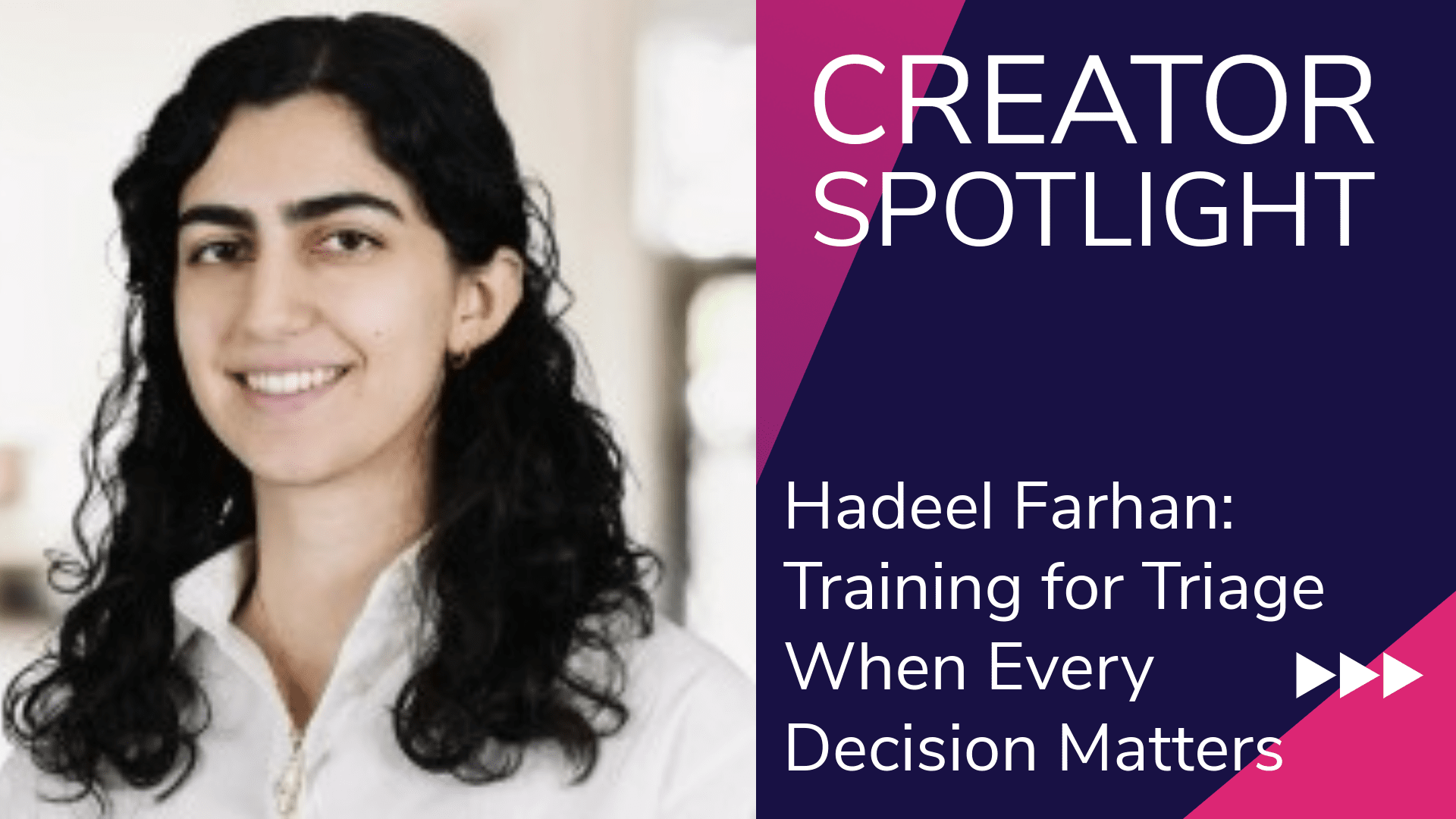
Who She Is
Hadeel Farhan is a Learning Technologist at Dubai Health, where she designs and implements technology-driven learning solutions for healthcare education. Her work spans interactive content, digital platforms, games, and immersive learning experiences, with a growing focus on how virtual reality can support clinical training and emergency preparedness.
[VR is] such a great way to experience things as a learner and to present ideas as an educator
Exploring VR in Healthcare Education
At Dubai Health, Hadeel works closely with research teams to evaluate how emerging technologies can be integrated into curricula and professional development. Virtual reality is still an evolving part of that ecosystem, but its potential is clear.
For Hadeel, immersive learning offers something traditional formats often struggle to deliver. It allows learners to experience complex, high-risk scenarios in a safe and controlled environment, while giving educators new ways to present ideas and assess decision-making.
From Concept to Experience
One of the aspects Hadeel values most about working in VR is the ability to quickly translate ideas into interactive experiences. Instead of lengthy back-and-forth development cycles, she can prototype, test, and refine scenarios herself.
"You get to translate exactly what you had in mind to this experience."
While this approach requires time and careful testing, the tradeoff is flexibility and creative control.
"You're not really looking for bugs. You're just making sure the logic plays out correctly."
A VR Triage Simulation for Emergency Training
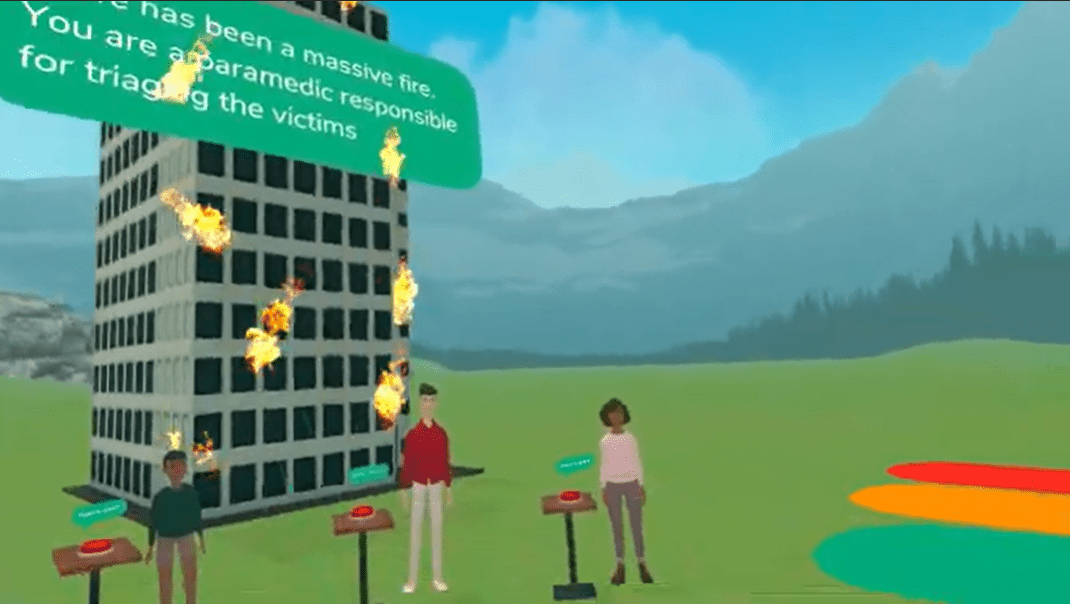
Hadeel’s featured VR project focuses on emergency response and patient triage, a critical skill in healthcare and disaster scenarios. The experience places learners inside a realistic but safe simulation where quick thinking and accurate assessment matter.
"As soon as you enter the experience, the first thing you see is a building on fire…"
Learners are introduced to a scenario involving multiple victims and must assess each one based on vital signs and mental state before taking action.
Just go for it. Put the headset on and play around.
What Learners Practice Inside VR
The simulation guides learners through hands-on decision-making rather than passive observation:
- Assess each victim using the provided information, such as pulse and responsiveness
- Choose the appropriate risk category using red, orange, or green tags
- Physically place wristbands on patients, mirroring real-world triage protocols
- Receive immediate feedback when a decision is incorrect
This structure encourages learners to reflect, adjust, and try again without fear of real-world consequences.
Learning Through Safe Mistakes
One of the strengths of immersive learning in healthcare is the ability to practice without causing harm. Hadeel intentionally designed the experience to allow mistakes and exploration.
There is no time limit and no real danger, but the pressure of the scenario still encourages careful reasoning and accountability. Feedback appears immediately, helping learners understand not just what was wrong, but why.
Expanding the Simulation
The current experience represents just one part of a larger educational intervention. Hadeel envisions additional layers that reflect real clinical complexity.
Future possibilities include:
- Secondary triage stages where patient conditions evolve over time
- Medical intervention decisions while waiting for emergency services
- Multiplayer scenarios that mirror team-based healthcare environments
For healthcare education, VR offers a unique balance. It provides realism without risk, repetition without fatigue, and experiential learning without logistical constraints. Learners can build confidence, test judgment, and internalize protocols in ways that are difficult to achieve through lectures or static simulations alone.
Hadeel sees immersive learning as a complement, not a replacement, for existing training models. It is a way to enhance preparedness and deepen understanding.
Build Safer Learning Experiences
Hadeel Farhan’s work highlights how immersive learning can support healthcare and emergency training by making practice more experiential, reflective, and human-centered. Through thoughtful design and accessible tools, VR becomes a space where learners can prepare for high-stakes moments before they happen.
If you are exploring virtual reality for healthcare education, emergency training, or clinical simulations, Zoe can help you move from concept to experience quickly. Create immersive learning environments that allow learners to practice, reflect, and build confidence when it matters most.
Download Zoe to begin building your own VR lessons, or join the Zoe Creator Program to learn alongside educators who are shaping the future of learning through creativity and exploration.