
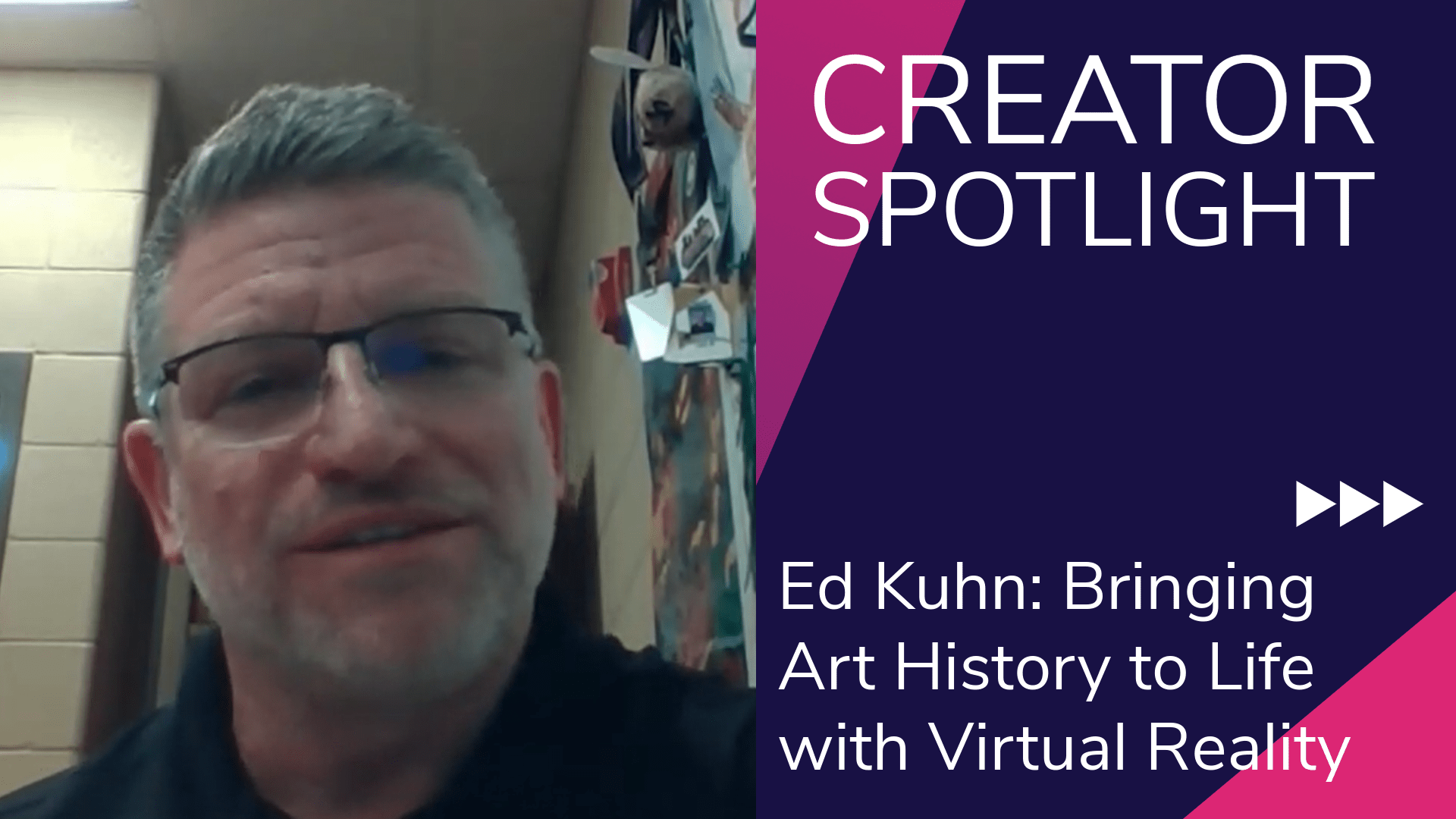
About Ed
For more than three decades, Ed Kuhn has taught high school art in rural Ohio. Over that time, his classroom has evolved along with the tools students use to create. But this year, he stepped into a new frontier: immersive learning. As one of the first teachers at his school to explore virtual reality, Ed is using VR to reimagine how students experience art history, interact with artists, and explore creative concepts beyond traditional materials.
While many VR initiatives begin in science or career and technical education, Ed’s work shows how powerful immersive learning can be for the arts. By building interactive environments through Zoe, he has created a way for students to learn art history through movement, exploration, and creative problem-solving.
I like the freedom of being able to choose what it looks like, how it functions, and how it interacts with the student.
Discovering VR as a Creative Tool
Ed is currently the only educator at his school using VR instructionally. His decision to explore immersive technology came from the same place his artwork does: curiosity and creative vision.
As an artist, he wanted a tool that gave him flexibility rather than a preconstructed experience made by someone else. Creating his own VR lesson offered the chance to design something aligned with his teaching style and artistic sensibility. Zoe made that possible by giving him enough freedom while keeping the process manageable.
Translating Artistic Vision into an Immersive Space
Like many creatives, Ed began with a large, ambitious idea. The challenge then became figuring out how to bring that idea into a functional VR lesson.
“I had to take that huge thing that was in my head and narrow it down and simplify it a little bit.”
To start small, Ed built an art history practice experience. Students enter a shared environment, examine different paintings, and match each work to its creator. When they place a painting on an easel, they are transported to another world themed around that specific artist.
What students encounter in VR:
- An initial landscape filled with paintings to explore
- Interactive prompts guiding them to match artworks with artists
- A teleportation mechanic that brings them into artist-specific mini worlds
- Spaces that contain more paintings and factual information to investigate
This structure allows students to learn about visual art actively instead of passively. The experience feels like a discovery rather than memorization.
Building Spaces That Grow Over Time
Ed sees this first prototype as the beginning of a much longer creative process. As his comfort with VR increases, he plans to expand each world with richer content and more interactive elements.
“If I were to continually use this, then semester after semester I would continue to build into those worlds.”
His long-term vision includes combining Zoe with Unity, which would give him greater control and complexity. While Unity has a learning curve, he sees the potential to design more intricate environments and add features that push the experience closer to what he first imagined.
I didn’t want something that was already built by somebody else. I wanted to build my own environment.
Why VR Belongs in Arts Education
Art classrooms have always been places of experimentation. VR adds a new layer of possibility, especially in areas like:
- Interactive art history
- Virtual galleries and exhibitions
- 3D sculpture and spatial composition
- Explorations of color, light, and perspective in immersive space
Ed’s project shows how VR can help students understand art in a way that feels tangible. Instead of viewing paintings on a page, they walk through environments shaped by the style, mood, and history of the artist.
Immersive learning also lowers barriers. Students who may not connect with traditional lectures can succeed when the content becomes something they can move through, touch, and interact with. By placing students inside the lesson, VR gives them agency as explorers.
Advice for Educators Interested in VR
For teachers looking to adopt VR but unsure where to begin, Ed recommends starting with support rather than going it alone.
His suggestion for educators:
- Begin with a guided program or training rather than piecing it together independently
- Experiment with small prototypes before building a fully realized lesson
- Choose tools that provide structure so the process is not overwhelming
- Think about VR as a practice space rather than only a presentation tool
Looking Forward
Ed’s first immersive project already enhances the way his students engage with art history. As he continues refining it and potentially integrating Unity, the experience will grow into a deeper, more complex environment. His willingness to experiment demonstrates how powerful VR can be in the arts, especially when guided by a creative vision.
By exploring immersive learning in a rural school setting, Ed is expanding access to innovative tools and illustrating that VR is not limited to STEM. It has a place in painting, storytelling, design, and the imaginative world of visual art.
Create Your Own Immersive Lessons with Zoe
If you want to bring immersive learning into your classroom or creative program, Zoe can help you design interactive virtual experiences that fit your teaching style.
Download Zoe to begin building your own VR lessons, or join the Zoe Creator Program to learn alongside educators who are shaping the future of learning through creativity and exploration.